

Ever wondered how effectively you’re turning income into wealth?
Discover the power of the Lifetime Wealth Ratio.The content on Surprising Wealth reflects my own experiences and opinions. It is not intended as financial, legal, or tax advice. Please consult a professional for advice tailored to your situation.
Can you really create significant wealth even with a median or lower income?
Absolutely, but it takes strategy and patience.
Tracking Our Lifetime Wealth Ratio: A Fun Metric for Financial Motivation
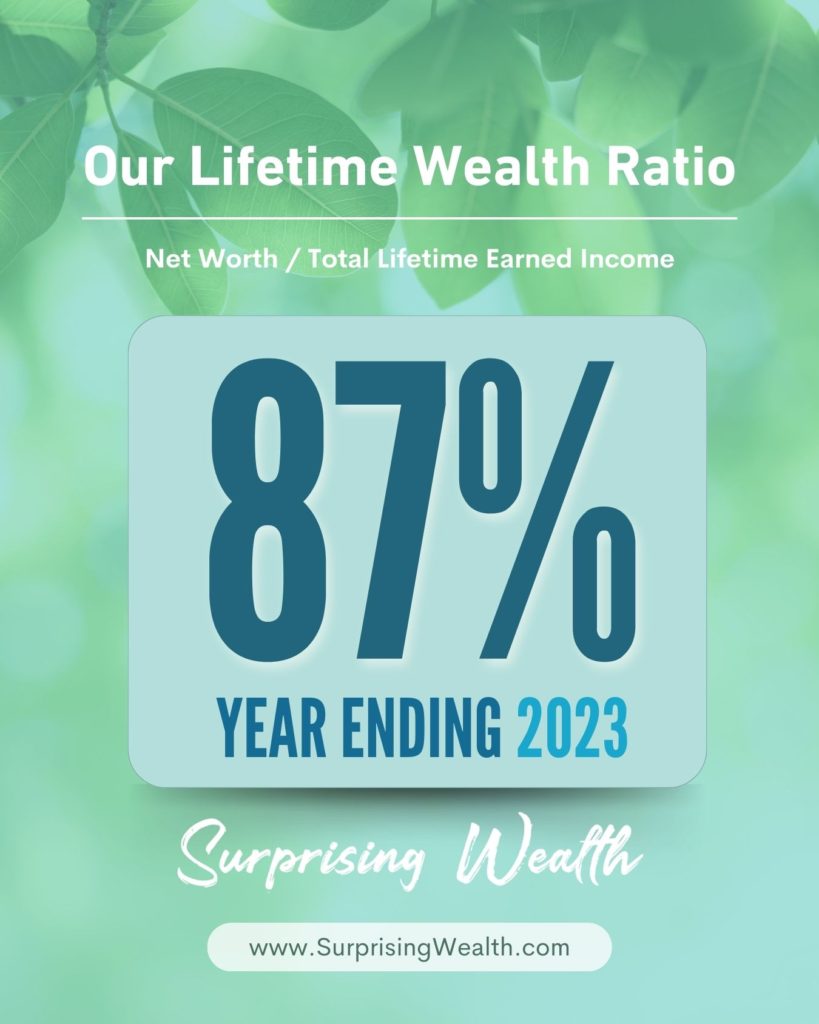
When it comes to financial health, one metric we find interesting is the Lifetime Wealth Ratio (LWR). This measure helps gauge how effectively you have converted your earned income into net worth through passive income and equity. Over the past four years, we’ve tracked our LWR, and it’s been a fun tool to keep us motivated and focused on our financial goals. As median income earners, it can feel daunting to hear about the Net Worth of people with high income jobs. From our side of the fence, it feels like accumulate big numbers might be relatively easy if you have a big earning shovel. But what if you have a “small shovel” life? That’s what I find appealing about the LWR metric, as it’s a ratio that shows your effectiveness at converting earned income into net worth, regardless of how much you earn.
What is the Lifetime Wealth Ratio?
The Lifetime Wealth Ratio is a straightforward concept. It calculates the percentage of your total earned income that has been converted into net worth. This includes savings, investments, real estate equity, and other forms of passive income. Essentially, it shows how well you are transforming your hard-earned money into long-term financial security. You can learn more about it here.
Our LWR Journey
Here’s a look at our LWR over the last four years:
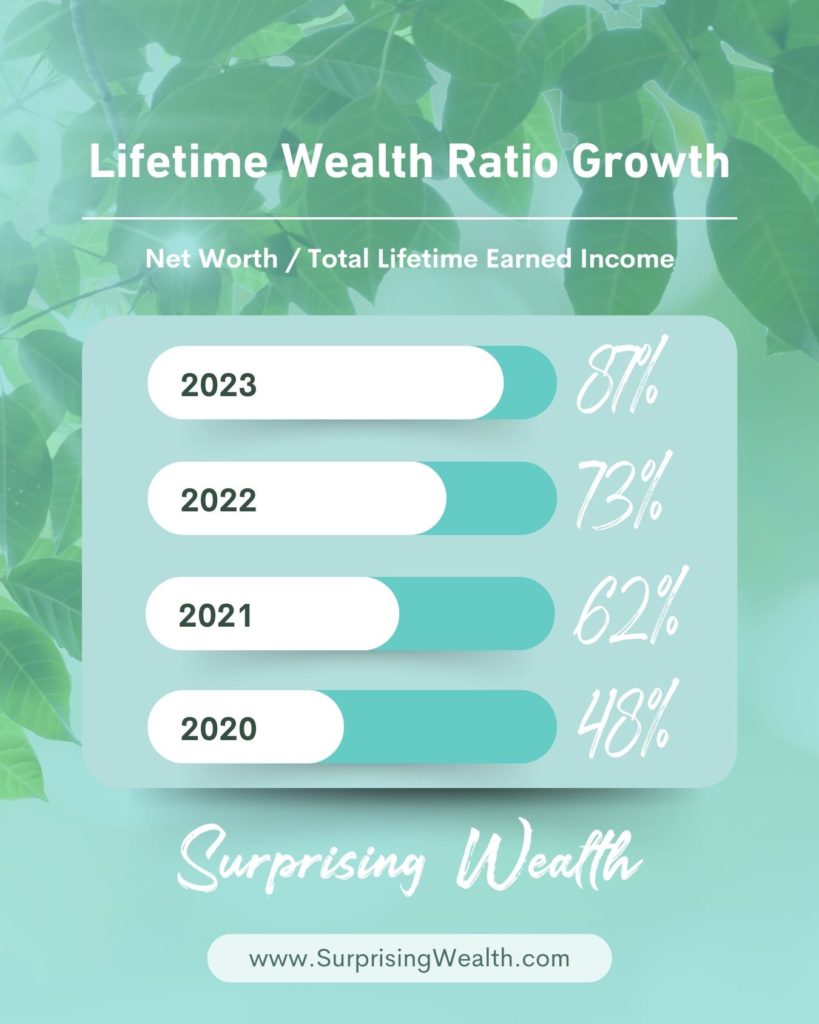
2020: 48%
In 2020, we became more intentional about tracking our net worth, moving from ballpark estimates to precise calculations. This allowed us to start measuring our LWR accurately. At that time, nearly half of our earned income had been converted into net worth, mostly tied up in real estate. This solid foundation highlighted the need to diversify and understand the equities market better. We also used recent real estate appreciation, helped by some home updates, to get PMI removed from our primary home mortgage. Due to the pandemic surprise, we put that savings in a separate account at the bank, increasing our emergency funds during an actual emergency, with the intention of investing all of it once we felt more comfortable that our income wasn’t in jeopardy.
2021: 62%
In 2021, our LWR surged to 62% due to several factors: a booming real estate market, disciplined savings, and strategic investments, such as putting all our stimulus money into our IRAs. We refinanced 2 mortgages to lower interest rates. We opened solo 401ks for our self-employed businesses, funded with the pandemic surprise of extra savings from spending more time at home. We thanked our lucky stars that our income streams were mostly steady though the pandemic shutdowns & aftermath.
2022: 73%
In 2022, our LWR climbed to 73%. We continued to manage our real estate investments, maxed our HSA and IRA contributions, continued our automated monthly investing despite the market downturn, and researched long term tax strategies. I researched bank and brokerage signup bonuses (since I wanted to move banks anyway) and invested that $1.3k into our retirement accounts. These actions boosted our net worth even in a tough market year.
2023: 87%
This past year, 2023, was our best yet, with our LWR reaching 87%. Our efforts to diversify our investments, along with the extensive growth in the housing market since 2020, provided a tailwind for our LWR. Our growing knowledge of the tax code, especially how it applies to small business owners and median income earners, allowed us to lower our effective tax rate. This resulted in us paying a smaller percentage of taxes relative to our total income when compared to the year before.
Why Lifetime Wealth Ratio Matters
The Lifetime Wealth Ratio is more than just a number; it’s a fun and motivating tool. Early in your earning career, your LWR is likely to be quite small. However, as the effects of compound growth take hold and you consistently take actions to build wealth, your progress starts to pick up. This can be seen in our LWR journey over the past few years.
How You Can Improve Your LWR
- Save and Invest Consistently: Prioritize saving and investing. Automate your savings and regularly contribute to your investment accounts.
- Diversify Income Streams: Explore ways to create passive income through index fund investing, side hustles, or real estate.
- Focus on Equity Growth: Invest in appreciating assets such as index funds (stocks) and real estate.
- Practice Tax Efficiency: Utilize tax-advantaged accounts, learn about the tax code for opportunities to optimize, and explore strategies to maximize your net income.
Discover the power of the Lifetime Wealth Ratio
Learn more about on our blog post: Ever wondered how effectively you’re turning income into wealth? Discover the power of the Lifetime Wealth Ratio
We cover:
- What is the Lifetime Wealth Ratio?
- Acknowledging the Grind: Encouragement for New Savers on the Path to Wealth
- Understanding the Challenges for Median to Lower Income Earners
- How to Calculate Your Net Worth
- How to Calculate Your Lifetime Wealth Ratio
- Why Lifetime Wealth Ratio Matters
- Strategies for Lower to Median Income Earners
Final Thoughts
Tracking our Lifetime Wealth Ratio has been a motivating part of our financial journey. It provides us with a clear picture of our financial health and a fun way to track our progress. Whether you are just starting or are well on your way to financial independence, understanding and improving your LWR can help you achieve your financial goals.
What steps are you taking to improve your Lifetime Wealth Ratio? Share your journey with us in the comments below!
#WealthBuilding #Investing #LifetimeWealthRatio#SmallAndMightyBusiness #SmallAndMightyRealEstateInvestor #SurprisingWealth
– – – –
A Bit About Us
Our journey began with humble beginnings. We’ve navigated through the challenges of creating a life and a living we love, while earing low to median incomes. What started as a modest dream of being able to retire someday has turned into a concrete plan. We’ve been on the SlowFI path, consistently saving and investing for 20+ years. Our income over time has stayed roughly in the 50th percentile, so we are truely everyday Americans. We’ve achieved remarkable results through living below our means and consistently investing the difference. Now in our mid-40s, we are in the top 20% for U.S. household wealth for our age group. This has been possible through conscious spending, consistent saving, strategic investing, and a commitment to lifestyle design where we spend generously on things that bring us value and contentment, while cuting back on things we are ambivalent about. It can be daunting when you hear the stories of tech workers or doctors or other people with large income shovels. We want to share how an everyday couple with median US income has built wealth for the future, while also creating a life we love today.
Why Financial Independence?
Financial Independence means having the freedom to make choices that aren’t dictated only by the need for a paycheck. It’s about gaining control over your time and energy, and being able to pursue what truly matters to you. For us, it’s about creating time for friend & family, travel, and the experiences that bring joy and fulfillment.
Join Us on the Journey
In January 2021, I ran some calculations, projected our investment growth, and analyzed our current spending levels. After adjusting our spending assumptions for future inflation, I realized we were on track to replace our earned income (trading time for money) with investment income (our money making money for us) in approximately 10 years. With 89 months left to go, we’re solidly on that path and we want you to join us. Whether you’re just starting out or well on your way to financial independence, Surprising Wealth is here to support and inspire you. Together, we can make every month count and turn dreams into reality.
Thank you for being a part of our community. Let’s embark on this journey to financial independence together!
Disclaimer: All the tips and stories here are from my own journey toward financial independence. Remember, what worked for me might not work for everyone. This content is for informational purposes only and should not be considered as financial, legal, or tax advice. Always consult with a professional before making any significant financial decisions.
%
CoastFI for Retirement
%
To LeanFI
%
To FIRE Number
Months To FI
Recent Blog Posts
Discover the power of small actions and big dreams with Surprising Wealth. Through a blend of personal anecdotes, case studies, and actionable tips, we’ll show you how we’re navigating the complexities of money management, investment strategies, and lifestyle choices to achieve true financial freedom and fulfillment.

The Best Car I Never Bought
I thought I was saving for my next car. It turns out I was really saving for something much bigger. Here’s how an unexpected opportunity transformed a future car purchase into the down payment on a rental property… and one of the best lessons we’ve learned about opportunity cost.

The Anti-Upgrade Mentality That Upgraded Our Entire Life
Every major purchase asks the same question: What else could this money become? Years ago, we started asking that question before upgrading our home or car. The answers reshaped our finances… and our lifestyle.
65 Months to FI – Practicing Looking for the Opportunity
65 months to FI! Just months after deciding to slowly wind down our rental portfolio, life accelerated the plan for us. Three long-term tenants moved out in rapid succession, giving us the unexpected opportunity to sell three properties this year instead of one. Twenty years ago, we couldn’t have imagined how much rental real estate would shape our Financial Independence journey. Today, we’re learning to embrace the evolution of that chapter.