

Our Retirement Investment Rate
2024 UpdateThe content on Surprising Wealth reflects my own experiences and opinions. It is not intended as financial, legal, or tax advice. Please consult a professional for advice tailored to your situation.
Most people overestimate what they can save in a month and underestimate what they can build in a decade.
Your wealth story isn’t written in one big leap… it’s built year by year, choice by choice.
Tracking Our Retirement Investment Rate: A Metric for Estimating Time to Financial Freedom
Tracking our Retirement Investment Rate over the past several years has been a powerful tool for understanding our financial growth. A savings rate is the percentage of income deliberately not spent. This simple metric reveals your financial priorities and directly impacts how quickly you can achieve goals like retirement, home ownership, or financial freedom. While most often called a “Savings Rate”, I prefer to think of it as an “Investing Rate”, because we are tracking our contributions to retirement funds and other investments that will give us financial independence.
What is a Savings Rate (or Investment Rate as I like to call it)?
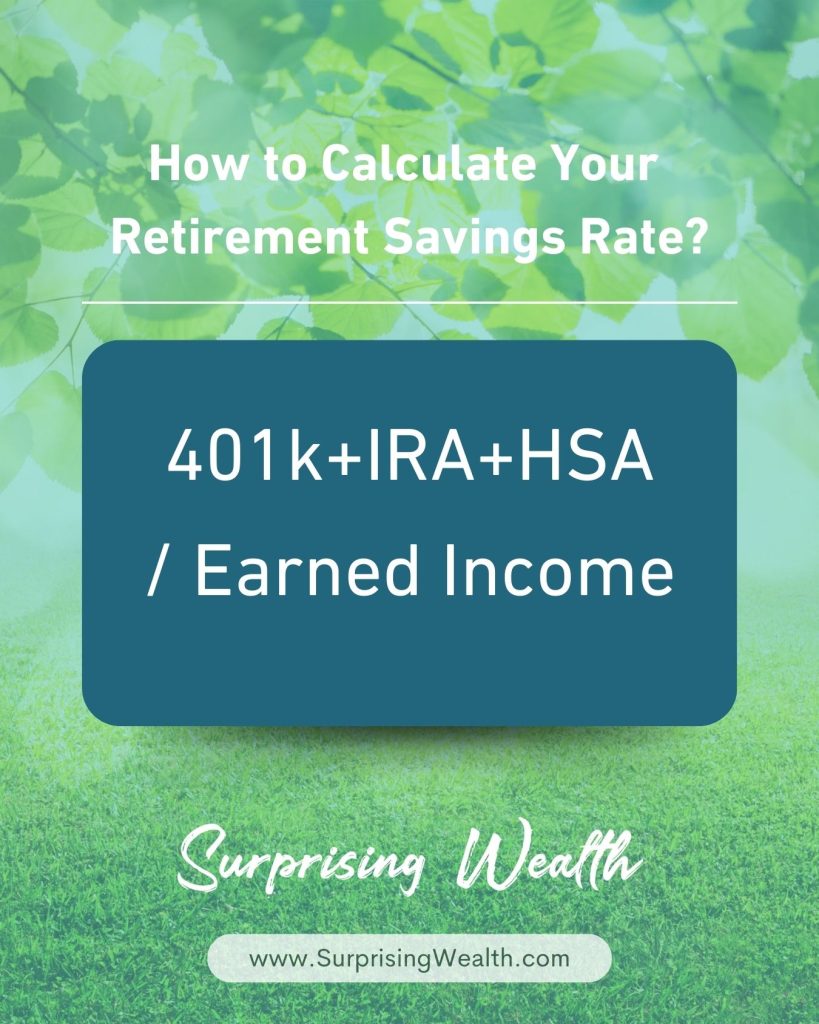
A Retirement Savings Rate measures what portion of your income you’re setting aside specifically for your future retirement needs through various investment vehicles like 401(k)s, IRAs, HSAs (if you are using them as a retirement account) and other long-term accounts. Your Retirement Savings (and Investing) Rate is the percentage of income you direct toward retirement accounts and investments. It’s calculated by dividing your retirement contributions by your total income and multiplying by 100%.
This key metric directly influences when you can retire and your future financial comfort. It helps you calculate how quickly your retirement nest egg will typically grow and when financial independence becomes possible. Higher savings rates get you to financial independence quicker.
Our Investment Rate Tracking Journey
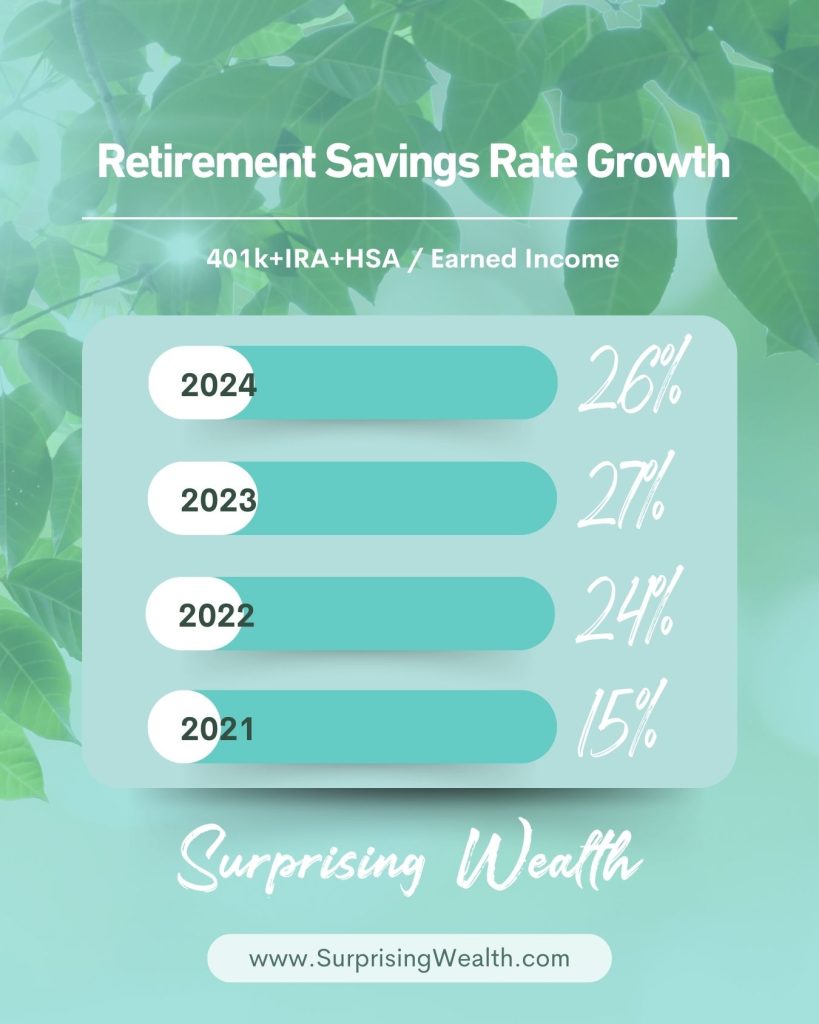
Here’s a look at our Retirement Saving/Investing Rate over the last four years:
2020: ?%
In 2020, we became more intentional about tracking our net worth, setting investment goals, and moving from ballpark estimates to precise calculations. At that time, nearly all of our net worth was in investment real estate with a small percentage in retirement accounts. This was a solid foundation, but the rapid changes in the real estate market highlighted the desire for us to diversify and understand the equities market better. Due to the pandemic surprise, we kept our usual relatively small retirement account contributions going, but I used the extra time at home to start learning about DIY stock market investing. We increased our savings but put it in a separate HYSA account at the bank, increasing our emergency funds while living through an actual emergency, with the intention of investing that money in retirement accounts once we felt more comfortable that our income wasn’t in jeopardy.
2021: 15%
In 2021, We opened solo 401ks for our self-employed businesses, funded with the pandemic surprise of extra savings from spending more time at home. We also committed to aggressively contributing to our HSA accounts now that we understood that we can invest that money for the future, rather than just letting cash sit in a bank account. (One small benefit of crappy insurance coverage is that we qualify for HSA accounts.) We thanked our lucky stars that our income streams were mostly steady through the pandemic shutdowns & aftermath.
2022: 24%
In 2022, I created an intentional retirement account investment plan. We committed to minimum investment goals, automating them with monthly transfers from our checking account. I also set optional stretch goals, with a plan for how we would use “extra” money that we felt comfortable investing after reaching our minimum objective. We continued to manage our real estate investments, maxed our HSA and IRA contributions, continued our automated monthly investing despite the market downturn, and researched long term tax strategies. I researched bank and brokerage signup bonuses (since I wanted to change banks anyway) and invested that $1.3k into our retirement accounts. These actions boosted our net worth even in a tough market year.
2023: 27%
Our growing knowledge of the tax code, especially how it applies to small business owners and median income earners, allowed us to lower our effective tax rate compared to prior years. This resulted in us paying a smaller percentage of taxes relative to our total income when compared to the year before. That, plus continuing our pandemic habits of eating in and enjoying mostly free entertainments (hikes in local parks, potluck gatherings with friends) or trading skills with friends for home improvement or auto repair projects, and limiting boredom shopping, meant that we could hit some of our stretch goals despite a small drop in annual income.
2024: 26%
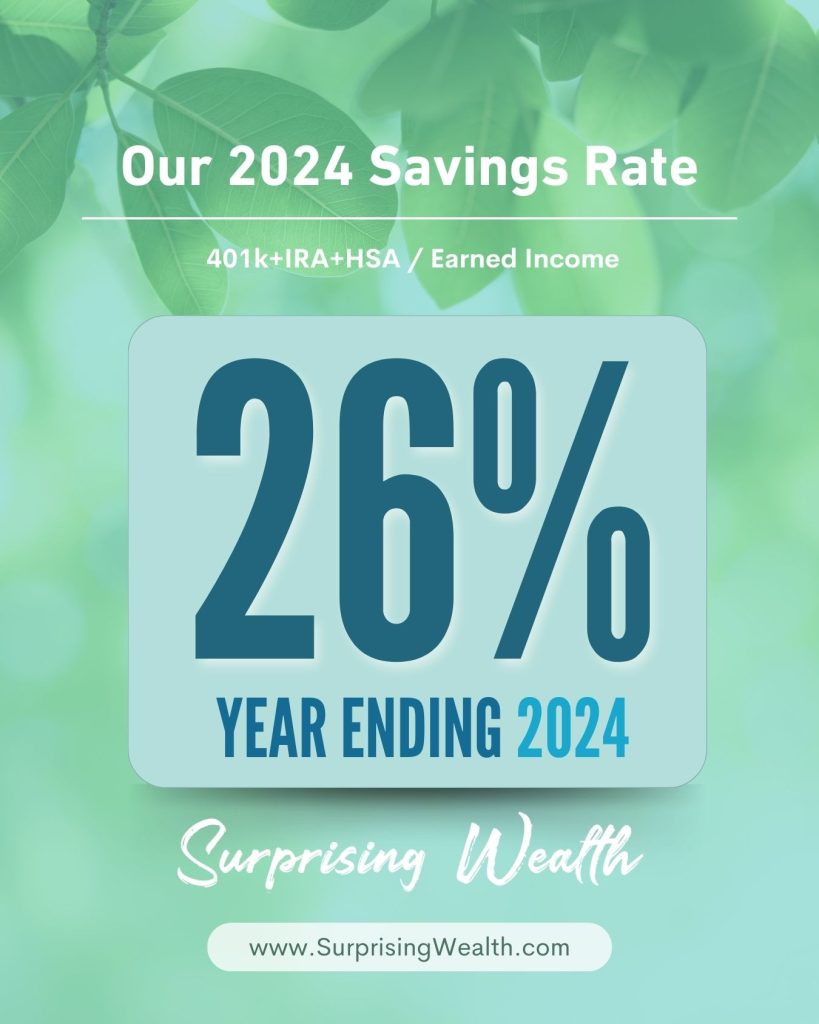
I’ll be honest here…. We’ve had a LOT of expenses this year. Mostly necessary and unsexy things like home repairs, ER visit & doctors bills, and other spending that is not fun to pay for. I’ve been feeling the squeeze of recent inflation more than prior years. Insurance and Property Taxes were up significantly. And 2025 has already seen quite a bit of similar spending. We are about to pay $6000+ to take down a beloved tree in our yard that is dying and cant be saved, despite working with an arborist. Some years are just this way. It’s the reason we also have sinking funds, in addition to our retirement savings, because we know big ticket spending items will eventually have to be handled. All that to say… I’ve been feeling like cashflow is tight and like I’m not getting where I want to be with our finances. But calculating our saving and investing rate for 2024 was eye opening. I can see that we are still making huge strides towards our financial independence goals and we are meeting and exceeding our retirement/FIRE investment plan for the year. Our everyday cashflow is tight. But I realized it’s partly because we are choosing to spend a lot on some things we love. I like to say that I (/we) spend lavishly on the things I want most: time freedom and financial freedom. Our biggest expense this year was our Retirement Savings at 26%, followed by Taxes (including self-employment FICA taxes) at 18%. That means we are living on about 56% of our income.
A Few Boring Notes About How We Track Our Investment Rate
If you don’t geek out on details, skip this section 😉
There are several methods for tracking your saving/investing rate. Pre-Tax vs Take-Home pay, Earned Income vs Total Income (includes interest, dividends, capital gains, passive income, etc). Your choice may depend on specific variables of how you earn money, the complexity of your earnings, and how that income is reported to you. Depending on the method you choose to track your savings rate, the same household could have wildly different percentages. The important thing is to calculate your savings ( and investing!) rate the same way over time, so your tracking is accurate. Because we are self-employed, have variable income, self-manage rental real estate, and never know exactly how much we earn each year until all the business tax returns are completed, it’s more tricky than a someone with a regular paycheck and simple portfolio.
Our Method: We choose to track our savings rate at the pre-tax level, only count our earned income, and only count funds invested for the long-term (6+ years or longer).
What does that mean?
Pre-Tax: We calculate the percentage of retirement savings compared to our total earned income before any taxes are paid… with one small caveat. We back out the portion of FICA* taxes that would normally be paid by an employer.
Only Earned Income: We only count earned income as the IRS would define it, and exclude income from existing investments such as interest, dividends, capital gains, passive income, bank bonuses, etc.
Sinking Funds: We do NOT include our savings for sinking fund in our savings rate. We put money aside for auto expenses, house mainainance, travel, emergency fund, etc. Because we are expecting to actually spend these funds over the short and medium term, so we do not include them in our retirement/investment/FIRE tracking.
*FICA combines Social Security and Medicare taxes for a total rate of 15.3%, but the cost is split between each employer and employee. 6.2% of an employee’s FICA taxable wages go to Social Security tax and 1.45% of their gross wages go to Medicare tax. The employer must match these percentages for a grand total of 15.3% in FICA Taxes. If you are self employed, you have to pay both the employee and employer taxes.
Let’s get curious….
Think back to a time when you made a decision with your future self in mind. What did you choose, and how has that paid off (or surprised you) over time?
If you renamed your “savings rate” to something more inspiring, like “freedom fund” or “dream life budget”, what would it change about the way you see it?
What’s something small you could automate today that would still feel meaningful 10 years from now? (A weekly investment deposit, a birthday fund, a future sabbatical savings plan?)
#WealthBuilding #Investing #InvestingJourney #SimpleWealth #LiveWellSpendWell #RetirementSavingsRate #MoneyWithMeaning #SurprisingWealth
– – – –
A Bit About Us
Our journey began with humble beginnings. We’ve navigated through the challenges of creating a life and a living we love, while earing low to median incomes. What started as a modest dream of being able to retire someday has turned into a concrete plan. We’ve been on the SlowFI path, consistently saving and investing for 20+ years. Our income over time has stayed roughly in the 50th percentile, so we are truely everyday Americans. We’ve achieved remarkable results through living below our means and consistently investing the difference. Now in our mid-40s, we are in the top 20% for U.S. household wealth for our age group. This has been possible through conscious spending, consistent saving, strategic investing, and a commitment to lifestyle design where we spend generously on things that bring us value and contentment, while cuting back on things we are ambivalent about. It can be daunting when you hear the stories of tech workers or doctors or other people with large income shovels. We want to share how an everyday couple with median US income has built wealth for the future, while also creating a life we love today.
Why Financial Independence?
Financial Independence means having the freedom to make choices that aren’t dictated only by the need for a paycheck. It’s about gaining control over your time and energy, and being able to pursue what truly matters to you. For us, it’s about creating time for friend & family, travel, and the experiences that bring joy and fulfillment.
Join Us on the Journey
In January 2021, I ran some calculations, projected our investment growth, and analyzed our current spending levels. After adjusting our spending assumptions for future inflation, I realized we were on track to replace our earned income (trading time for money) with investment income (our money making money for us) in approximately 10 years. With 89 months left to go, we’re solidly on that path and we want you to join us. Whether you’re just starting out or well on your way to financial independence, Surprising Wealth is here to support and inspire you. Together, we can make every month count and turn dreams into reality.
Thank you for being a part of our community. Let’s embark on this journey to financial independence together!
Disclaimer: All the tips and stories here are from my own journey toward financial independence. Remember, what worked for me might not work for everyone. This content is for informational purposes only and should not be considered as financial, legal, or tax advice. Always consult with a professional before making any significant financial decisions.
%
CoastFI for Retirement
%
To LeanFI
%
To FIRE Number
Months To FI
Recent Blog Posts
Discover the power of small actions and big dreams with Surprising Wealth. Through a blend of personal anecdotes, case studies, and actionable tips, we’ll show you how we’re navigating the complexities of money management, investment strategies, and lifestyle choices to achieve true financial freedom and fulfillment.

The Best Car I Never Bought
I thought I was saving for my next car. It turns out I was really saving for something much bigger. Here’s how an unexpected opportunity transformed a future car purchase into the down payment on a rental property… and one of the best lessons we’ve learned about opportunity cost.

The Anti-Upgrade Mentality That Upgraded Our Entire Life
Every major purchase asks the same question: What else could this money become? Years ago, we started asking that question before upgrading our home or car. The answers reshaped our finances… and our lifestyle.
65 Months to FI – Practicing Looking for the Opportunity
65 months to FI! Just months after deciding to slowly wind down our rental portfolio, life accelerated the plan for us. Three long-term tenants moved out in rapid succession, giving us the unexpected opportunity to sell three properties this year instead of one. Twenty years ago, we couldn’t have imagined how much rental real estate would shape our Financial Independence journey. Today, we’re learning to embrace the evolution of that chapter.